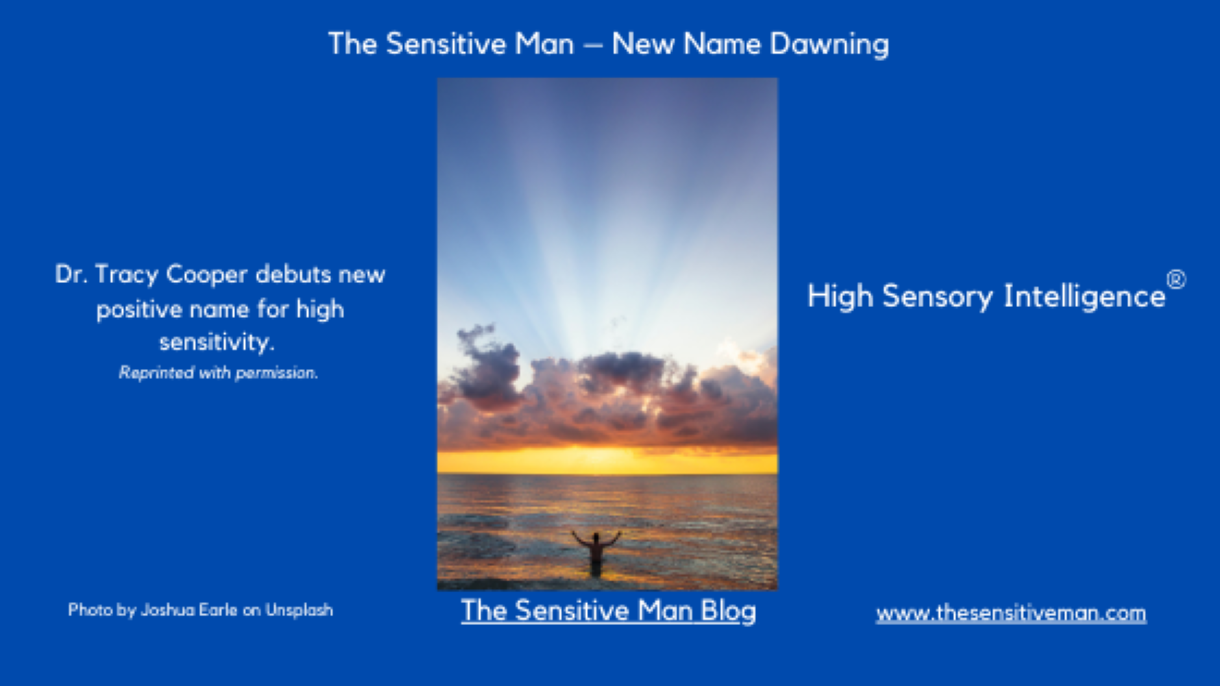
 Dr. Tracy Cooper is debuting a new, more positive name for Highly Sensitive Person. The guest article is his previously published announcement for how the new name came about and why it was chosen. Reprinted with permission.
Why I Am Now Using the Term High Sensory Intelligence Instead of Highly Sensitive Person Dr. Tracy Cooper, Ph.D. The use of the word ‘intelligence’ may raise a few eyebrows but allow me to lay out a simplified way we can reasonably and accurately use ‘High Sensory Intelligence’ as a better, non-stigmatizing popular culture term than the existing ‘Highly Sensitive Person,’ which carries with it deep emotional and cultural weight for many of us who identify with sensory processing sensitivity. Preface these remarks with this statement, I am NOT offering ‘High Sensory Intelligence’ as a replacement term for Sensory Processing Sensitivity (SPS). SPS is the clinical scientific name you will see in the peer-reviewed journal articles. Sensory Processing Sensitivity will always be the official name of the trait originated by Elaine Aron, Ph.D. The pop culture term that is used out in the world, though needs to be immediately positive in tone, free of any negative stigma, and purpose driven; Highly Sensitive Person does not fulfill that role. I believe that ‘High Sensory Intelligence’ can serve us quite effectively. I realize that the use of the word ‘intelligence’ bears defining and articulating a rationale for its usage without getting beyond the scope of the way the word ‘intelligence’ is being used. There are many theories of intelligence but the one that I have found to be most appropriate in the way that I suggest relates to the work of cognitive psychologist, Scott Barry Kaufman, Ph.D., who has a particularly interesting personal story that many people who identify with Sensory Processing Sensitivity may also find compelling and that led him to suggest that a new way of looking at intelligence was needed. Scott’s story involves high test anxiety on IQ tests and his poor performance and classification as a special needs student until he was in 9th grade. IQ testing is primarily focused on linear reasoning and has its utility in predicting many factors in one’s life but is limited in its ability to encapsulate the real world of how humans live and develop over a lifetime. Enter Kaufman’s work to reframe intelligence, and education, as inclusive of the whole person and how we might honor curiosity, openness, creativity, and exploration. In his dual processing theory of intelligence, Kaufman integrates prior work, such as Gardener’s theory of multiple intelligences, which posits that intelligence is not finite, with his own unique perspective on the role of spontaneous forms of thinking, intuitive thinking, daydreaming, imaginative play, and learning that occurs incidentally (implicit learning). The way humans adapt to the demands of a given task, often increasing our capacities beyond our potential allows us to think of ‘intelligence’ as fluid, developmental, and real-world oriented. How does this include those who identify with sensory processing sensitivity? Sensory processing sensitivity is a personality trait, or adapted psychological mechanism, that evolved through the natural process of necessity meeting potential. In our hunter-gatherer period, not so long ago in geological time, humans needed to ‘read’ the natural environment with great skill to know where to find resources, viable areas for tribes to live at different points in the year, and to stay safe. Those who were higher in an overall sensitivity to both the natural and interpersonal environments proved to yield a slight advantage on the average, so sensory processing sensitivity remained in the gene pool to be passed down through the generations. In that vast time period, it was simple to understand the how and why of 15-20% of the population being more open and aware of danger but also opportunities. This developmental and whole-person view of intelligence imparts an intentionality and purpose to our lives as High Sensory Intelligence people. Many of us report being stigmatized early in life for a variety of reasons but imagine if there had been advocates and professionals in society utilizing different terminology to describe Sensory Processing Sensitivity! How much more accessible and inviting would it have appeared if High Sensory Intelligence were used to describe the intuition, deeper processing, high empathy, emotional range, and awareness of subtle nuance that Sensory Processing Sensitivity is known for? It is staggering and sobering to have to acknowledge the shallow and superficial level of rational thinking in our species where first-reaction judgements become set in stone, as with ‘highly sensitive person.’ If we truly wish for Sensory Processing Sensitivity to reach the 15-20% of the world’s population with this natural and neutral personality trait, we need to be adaptable enough in our messaging to recognize when a ‘pivot’ is necessary to move away from the stigma attached to a simple term. In short, there is a better term available that is adequately descriptive of the D.O.E.S. core features of Sensory Processing Sensitivity that is positive in tone and stigma free, High Sensory Intelligence. For those who speak or write about Sensory Processing Sensitivity often, here is a brief synopsis you might use to describe High Sensory Intelligence: High Sensory Intelligence is a personality trait with a purpose and that is to help all of us survive through changing and challenging times and circumstances. High Sensory Intelligence is
Please comment below.
2 Comments
|
AuthorBill Allen currently lives in Bend, Oregon. He is a certified hypnotist and brain training coach at BrainPilots.com. He believes that male sensitivity is not so rare, but it can be confounding for most males living in a culture of masculine insensitivity which teaches boys and men to disconnect from their feelings and emotions. His intent is to use this blog to chronicle his personal journey and share with others. 
Archives
July 2024
Categories
All

|
 RSS Feed
Proudly powered by Weebly