 A Blog about Sensory Processing Sensitivity from the Worldview of a High-Sensing Male
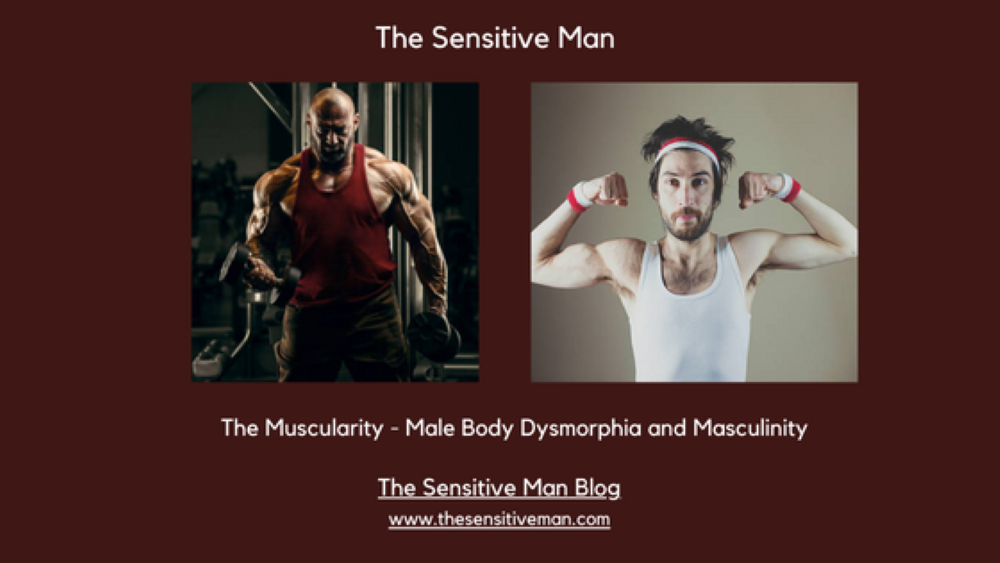
Male culture, especially in the West, emphasizes that the larger, bigger, and more muscular a man is, the more masculine he becomes. This emulation is exhibited with our sports heroes, such as football players, basketball players, boxers, wrestlers, weightlifters, and many other male athletes, male models, and actors. This desire for bigger and stronger men often leads young men and boys to attempt to measure up and obtain that same athletic build and mass. In and of itself, it is not necessarily bad in moderation, but problems ensue when it becomes an obsession. When this aspiration becomes a compulsion, we have fertile ground for complications and potential physical and mental health troubles. The Obsession with Big The emphasis with men about physicality traces its roots to more primitive times when muscular men often meant the difference between bagging big game or protecting against predators or interlopers. Like most large apes, humans often mimic the posturing that large apes use to set up parameters for dominance. In this case, usually, size does matter. In this sense, we have evolved little from our ancestors in prioritizing males' size. This rule of thumb applies to everything from body mass, muscle size, height, weight, and, of course, penis size. We have "Texas-ized" the entire male anatomy for bigness. All of these physical parameters suggest some form of dominance. We have trans-morphed this ideal to represent masculine desirability and have, in some ways, created this cult of bigness. Where this goes wrong. Whereas women often emphasize smallness or thinness, men have classically focused on being large and threatening. This can often lead men to OCD behaviors. One of them is body dysmorphic disorder or BDD, a mental disorder that leads an individual to believe there is a serious flaw in some aspect of their body. A subset of this disorder, muscle dysmorphia, is where the individual, primarily men, believes that their muscles are too small or underdeveloped. This thinking can occur even when the individual has well-defined and developed musculature. Causes range from genetics to introversion, perfectionism, heightened aesthetic sensitivity, and early childhood abuse. And now, with the advent of social media – social pressures mount related to comparison to others in the news. Although numbers indicate that a small number of individuals reach the obsessive stage (< 3.0% of the population), it is also a cultural phenomenon wherein men feel less masculine with less-than-desirable bodies. Hence, the proliferation of gyms and weightlifting equipment. This fanatic devotion to body size leads many men to experience personal rejection sensitivity, or as its sounds, a fear of being rejected or negatively evaluated by others. The emphasis on body size can begin early with males as young as six. Research shows that up to 95% of college-age men have some degree of body dissatisfaction. This cultural obsession with muscularity leads many men to develop some form of muscle dysphoria. This compares numerically with the incidence of anorexia nervosa in women. Always struggling for an idealized body image, made possible through media, advertising, and idealized cultural norms. A study from the International Journal of Men's Health found that male college students prioritized appearance evaluation and accounted for 20 percent of participants' psychological self-acceptance. Furthermore, body image correlates positively with the perception of male dominance and environmental self-mastery. In addition, the study cited an increase in steroid and supplement use for increased body size related to weight preoccupation and body dissatisfaction. Again, the strong adherence to traditional masculine norms is related to higher levels of body dissatisfaction. This image evoked from traditional masculinity suggests the ideals of power, control, strength, independence, and dominance in defining manhood and is indicated in body image. The study concluded that our society's continued emphasis on male and female ideals based on restrictive body images had become markers of male and female status. The downside of all this is a culture that ignores the variety of body types, the potential richness of male experience outside of body type, and the development of an anchored, well-developed identity. Where masculinity goes wrong. Many have coined the phrase "bigorexia" to supplant reverse anorexia. But, unfortunately, the upshot for many men is that no matter what they do to bulk up, it is never enough. Hence, even with countless hours in the gym, ingesting dangerous drugs, and questionable supplements, they can not fulfill a never-satisfied goal of being manly enough. Growing up in the sixties, I remember the ads for Charles Atlas in the comic books, promising to make a 90-pound weakling into a muscular beast, fit to protect any damsel in distress, kick-ass, or at least sand on any beach in America. And, of course, expectations are set young in life. I mean, what young man wouldn't want to look like a stud on the beach, by the pool, or anywhere he shows off his "guns." You see, our definition of masculinity is based on never enough. Never enough muscles, never enough courage, never enough body mass, never enough strength. You see, no one can ever be enough to be man enough. The masculine promise of the dominance of control or being the baddest mofo on the block is based on never enough. It's never about creativity, emotion, giving, being cerebral, or just being a decent human being. This. my friends, is toxic masculinity at its worst. And we have all bought into it at some point. In the end, based on this definition, no man will ever be enough. It's time to throw the yoke off and let men evolve into the fine humans they are, regardless of their body shape. Embrace the diversity within the male gender, body size, brain capacity, well-developed feelings, and the capacity to cooperate and love. We need to leave that old shit behind, give it back to the caveman and banish it to the annals of time. My Observations I was always a tall, skinny kid. I grew upward faster than I could add weight. I wish that were true now. Those old Charles Atlas ads painted my internal image of myself – the image that didn't match the ad. Unfortunately, I was never manly enough according to those ideals. I lifted weights, drank protein drinks, and ate until I couldn't hold any more food, but to no avail. I remained the skinny, tall kid. Later in life, I would add weight and fill in, but by then, it didn't matter anymore. I don't think it's wrong to work out to build muscle, add strength, or be more fit. But that's not what this article is about. Some of us will never be the idealized, muscular athletes we see on television sporting events. That needs to be okay. Likewise, we need not idealize big over smart, dominance over kindness, or competitiveness over cooperation. Being masculine isn't about big. It's about being human in male form and expressed in the infinite variety of the human genome. What do you think?
1 Comment
|
AuthorBill Allen currently lives in Bend, Oregon. He is a certified hypnotist and brain training coach at BrainPilots.com. He believes that male sensitivity is not so rare, but it can be confounding for most males living in a culture of masculine insensitivity which teaches boys and men to disconnect from their feelings and emotions. His intent is to use this blog to chronicle his personal journey and share with others. 
Archives
July 2024
Categories
All

|
 RSS Feed
Proudly powered by Weebly